
Smart Coffee vs café aux champignons
Le café aux champignons — des marques comme Four Sigmatic, London Nootropics, RYZE, Bonjour — combine du café avec des extraits de champignons fonctionnels, généralement la Crinière de lion, le Cordyceps, le Chaga et le Reishi.
Là où le café aux champignons est vraiment bon :
La Crinière de lion à des doses adéquates (750 mg et plus d'extrait de corps fructifère) a démontré un soutien à la synthèse du facteur de croissance nerveuse (NGF) — pertinent pour la santé cognitive et la neuroplasticité. Le Cordyceps soutient la production d'ATP et l'utilisation de l'oxygène. Le Reishi possède des propriétés adaptogènes et anti-inflammatoires. Ce sont des avantages réels, cliniquement prouvés, lorsque les champignons sont présents à des doses appropriées.
Là où le café aux champignons est insuffisant :
La plupart des cafés aux champignons contiennent un stack fonctionnel étroit — des adaptogènes et des champignons, parfois de la L-Théanine. Ils ne contiennent pas de collagène, de vitamines B méthylées, de TCM C8/C10, de chrome, de magnésium, ou de support micronutritionnel significatif. Ce sont des compléments cognitifs, pas des systèmes nutritionnels complets. Pour quelqu'un qui ne recherche qu'un soutien à la concentration, un café aux champignons de qualité est un choix légitime. Pour quelqu'un qui veut l'intégralité de sa base nutritionnelle matinale en une seule tasse, le café aux champignons est incomplet.
Smart Coffee vs Café aux champignons :
Smart Coffee inclut de la L-Théanine et du Panax Ginseng pour l'aspect cognitif/adaptogène, ainsi que 16 ingrédients supplémentaires que le café aux champignons n'aborde pas. Si vous voulez spécifiquement les champignons, Smart Coffee n'est pas le bon produit. Si vous voulez la formule matinale fonctionnelle la plus complète en Europe, le café aux champignons n'est pas suffisant.
Smart Coffee vs Matcha
Le matcha – thé vert en poudre – a gagné sa réputation. Il contient de la L-théanine naturellement présente aux côtés de la caféine (environ 70 mg par portion), des catéchines (antioxydants aux propriétés anti-inflammatoires) et de la chlorophylle.
Là où le matcha est vraiment bon :
La combinaison naturelle de L-théanine et de caféine dans le matcha produit une vigilance calme et soutenue que la plupart des buveurs de café trouvent plus douce que l'expresso. La teneur en antioxydants est réelle. Le matcha est l'une des rares boissons dont l'efficacité est légitimement prouvée pour le soutien cognitif et métabolique.
Là où le matcha est insuffisant :
Le matcha est une boisson. Ce n'est pas un système nutritionnel. Il ne contient PAS de collagène, de TCM, de vitamines B, de magnésium, de chrome, d'adaptogènes ou d'acides aminés en quantités fonctionnelles.
Smart Coffee vs Matcha :
Pourquoi se battre ? C'est la raison pour laquelle nous avons créé Smart Coffee Matcha.
Il contient la synergie qui rend le matcha précieux, ainsi que 17 ingrédients fonctionnels supplémentaires (y compris le myo-inositol et la glycine).
Un buveur de matcha qui prend également des suppléments séparément fait la moitié de ce que Smart Coffee fait en une seule étape.
Smart Coffee vs boissons énergisantes
Les boissons énergisantes — Red Bull, Monster, Celsius et leurs successeurs fonctionnels — constituent la catégorie de boissons qui connaît la croissance la plus rapide en Europe. Certaines nouvelles boissons énergisantes fonctionnelles sont véritablement plus sophistiquées que leurs prédécesseurs.
Là où les boissons énergisantes sont systématiquement défaillantes :
Même les meilleures boissons énergisantes sont construites autour d'une forte teneur en caféine (150-300 mg), souvent associée à des vitamines B synthétiques sous des formes bon marché, et dans la plupart des cas, du sucre ou des édulcorants artificiels en quantités qui sont pro-inflammatoires à long terme. Ce sont des systèmes de distribution de stimulants. Ce ne sont pas des systèmes nutritionnels. L'énergie qu'elles produisent est réelle. Le contrecoup qui s'ensuit l'est aussi. L'apport nutritionnel est proche de zéro.
De plus, la plupart des boissons énergisantes contiennent de la cyanocobalamine (B12 bon marché) plutôt que de la méthylcobalamine, et de l'acide folique plutôt que du méthylfolate — des formes moins efficaces pour une proportion significative de la population.
Smart Coffee vs Boissons énergisantes :
Smart Coffee contient 80 mg de caféine — une dose modérée et soutenue qui agit en synergie avec la L-théanine pour produire de la vigilance sans anxiété. Il ne contient ni sucre, ni édulcorants artificiels, ni pic de caféine à forte dose. Il apporte une véritable valeur nutritionnelle en plus de son effet stimulant. Ce n'est pas un dopant. C'est une base de performance.
Smart Coffee ou compléments pris séparément
C'est la comparaison la plus honnête, car de nombreux clients de Smart Coffee remplacent une pile de suppléments existante.
Une pile de suppléments quotidiens comparable comprendrait : collagène Peptan® (35-40 €/mois), bisglycinate de magnésium (18 €/mois), complexe B méthylé (15-20 €/mois), huile de TCM C8/C10 (20 €/mois), L-théanine (12 €/mois), picolinate de chrome (8 €/mois), extrait de ginseng Panax (15 €/mois).
Total : environ 123-130 €/mois pour des versions de qualité de chacun.
Smart Coffee coûte environ 38 €/mois (un sachet, 25 portions, une portion par jour). Au prix de l'abonnement, 32,30 €/mois.
L'argument en faveur de la prise de suppléments séparément est la personnalisation : vous pouvez choisir des marques et des doses exactes pour chaque ingrédient indépendamment. L'argument contre est l'observance. Les recherches montrent constamment que les routines de supplémentation impliquant plus de deux produits ont des taux d'observance significativement plus faibles après 90 jours.
Une tasse de café que vous alliez boire de toute façon est le mécanisme de livraison de supplément le plus efficace en termes d'observance disponible.
Le bilan honnête
Smart Coffee a été créé par un ingénieur chimiste spécialisé en biochimie, et une nutritionniste clinique et naturopathe.
La formule contient 17 ingrédients actifs biodisponibles, chacun choisi pour sa forme spécifique, sa dose clinique et sa contribution synergique au système global. Il regroupe en une seule tasse matinale ce qui nécessiterait autrement cinq suppléments distincts. À environ 1,52 € par portion, c'est l'ensemble de suppléments premium le plus économique disponible sur le marché européen.
Il est sans sucre, sans lactose, sans gluten et compatible avec le régime cétogène. Il est fabriqué dans des conditions certifiées BPF et testé par lots pour la pureté. Toutes les allégations de santé sur le site Web et l'emballage utilisent un langage autorisé par l'EFSA.
Ce n'est pas votre café ordinaire et vous êtes trop exceptionnel pour être ordinaire.
Créer une cohérence
Un rituel qu'on n'oublie jamais

Étape 1
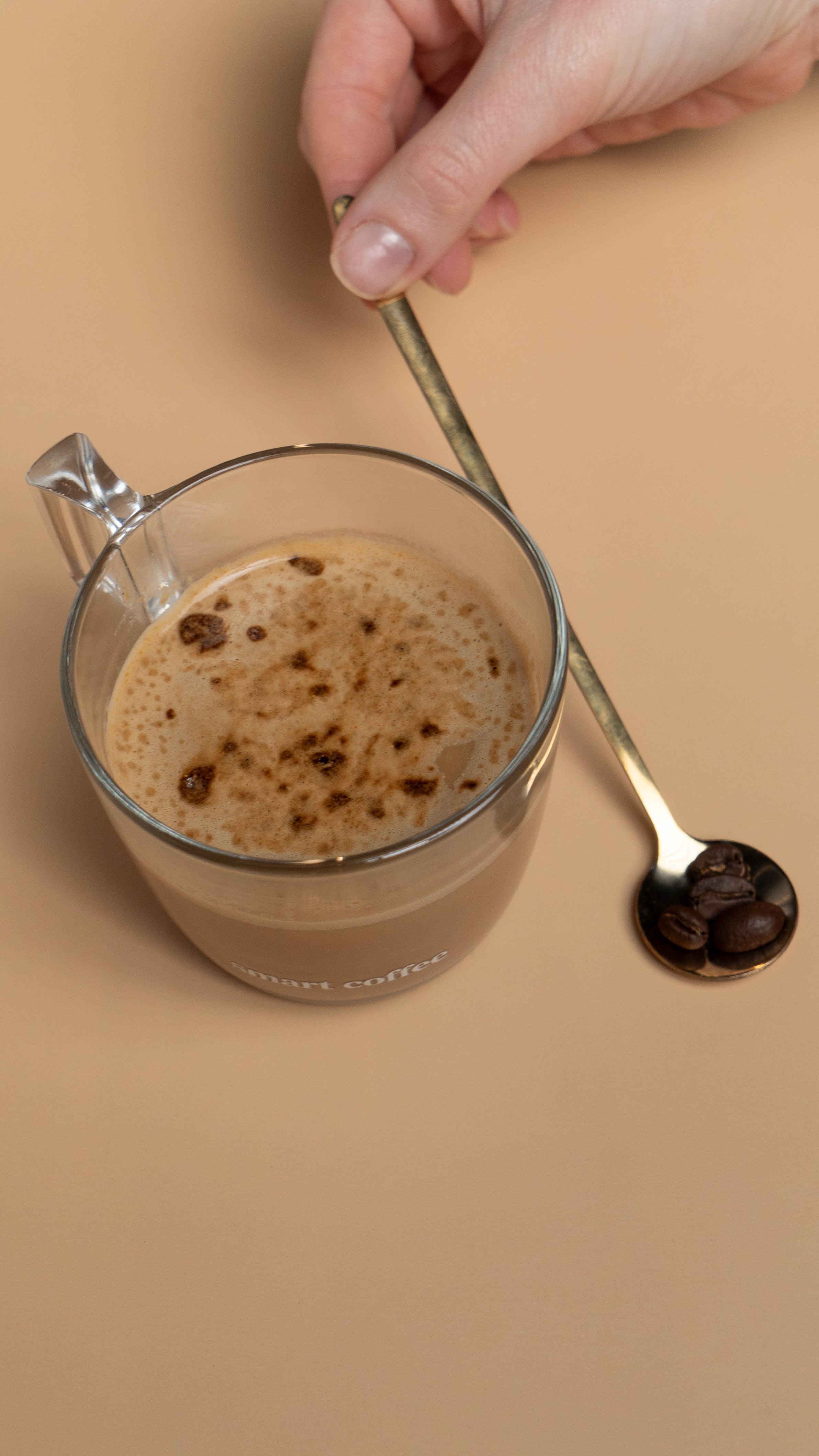
Prenez 12 g de Smart Coffee
Étape 2
Obtenez 100-200 ml d'eau chaude ou de lait

Étape 3
Faites preuve de créativité et amusez-vous !
Vous pouvez le boire comme vous l'aimez.


Note des fondateurs
Smart Coffee est né de notre propre difficulté quotidienne : nous voulions une énergie propre, une concentration plus nette et un soutien métabolique, sans avoir à courir après une douzaine de produits. Priscila, Ingénieure Chimiste, et Camila, Nutritionniste avec des qualifications en naturopathie, ont combiné science et nutrition pratique pour créer un café fonctionnel qui simplifie et optimise votre routine.
Chaque ingrédient a un but, chaque dose est étudiée et chaque tasse est conçue pour vous accompagner tout au long de votre journée — aucune pilule supplémentaire n'est requise. Fabriqué dans l'UE, guidé par les preuves et conçu pour les vies modernes.
FAQ
Smart Coffee est-il meilleur que le café aux champignons ?
Pour un soutien nutritionnel complet — collagène, vitamines B, TCM, minéraux — oui. Pour les bienfaits spécifiques aux champignons (Crinière de Lion, Cordyceps), les marques de café aux champignons dédiées offrent des doses de champignons plus élevées. Smart Coffee inclut du Panax Ginseng comme adaptogène, et non des champignons.
En quoi Smart Coffee se compare-t-il à AG1 / Athletic Greens ?
AG1 contient des traces de chaque ingrédient qu'ils ont – ce qui signifie qu'il ne crée pas de réelles différences transformatives. AG1 est également beaucoup plus cher à 80-100 €/mois.
Puis-je boire du Smart Coffee à la place du café ordinaire ?
Oui. Il contient 80 mg de caféine par portion — l'équivalent d'un expresso modéré. Il est conçu pour remplacer entièrement votre café du matin tout en apportant un soutien nutritionnel complet.
Smart Coffee est-il adapté au jeûne intermittent ?
Le Smart Coffee contient des graisses TCM et du collagène, qui apportent des calories et peuvent techniquement rompre un jeûne calorique.
Mais il ne rompt PAS un jeûne métabolique - Il ne provoque pas de pic d'insuline (la stévia n'a aucune incidence sur l'insuline ; les TCM ne déclenchent pas l'insuline). Pour le jeûne métabolique, le Smart Coffee est compatible. Pour un jeûne calorique strict, utilisez l'échantillon pour tester votre protocole personnel.
Où le Smart Coffee est-il fabriqué ?
Smart Coffee est formulé et fabriqué en Europe, en Slovaquie, et est expédié dans toute l'Europe. Toute la fabrication est certifiée GMP et testée par lots selon les normes de sécurité alimentaire de l'UE.
Les vitamines B (niacine, B6, folate, B12) contribuent à un métabolisme énergétique normal et à réduire la fatigue. Le magnésium contribue à une fonction musculaire normale et à des fonctions psychologiques normales. La choline contribue à un métabolisme lipidique normal et à une fonction hépatique normale. Le chrome contribue au maintien d'une glycémie normale et au métabolisme normal des macronutriments. Toujours consommer dans le cadre d'une alimentation variée et équilibrée et d'un mode de vie sain.